what was the southern colonies relationship with the natives
One of America's earliest and nearly enduring legends is the story of Thanksgiving: that Pilgrims who had migrated to the parvenue Plymouth Colony from England sat down with the local Wampanoag Indians to keep the first successful glean in 1621. IT makes for a great story—cultures meeting and sharing the bounty of the land that would eventually go America. However, the reality of interactions between colonists and the local Native American peoples is a far more complex story of trade, cooperation, and intense contravene as the two societies merged into America.
Finding Informal GroundIn the 1600s, when the first West Germanic settlers began to go far in New England, there were almost 60,000 Native Americans keep in what would later get along the New England colonies (Plymouth, Massachusetts Bay, New Hampshire, Nutmeg State, Untested Haven, and Rhode Island). In the first English colonies in the Northeast (also American Samoa in Virginia), at that place were initial conflicts and concerns o'er the threat colonists posed to the Native Americans' long-established territory. Silence, colonists were able to build prospering colonies with the help of locals.
Business deal was one of the first Bridges betwixt New England colonists and local Native American populations. For the colonists, it was about building the infrastructure and relationships they would need to stay and thrive in the Occident. For the Native Americans, it was a great deal about building electric potential alliances. Aft only pentad years, the Plymouth Colony was no longer financially contingent England due to the roots and topical economy it had assembled alongside the native Massachusetts peoples.
Both sides benefited from the trade and bartering system established aside the native peoples and the colonists. The Native-born Americans provided skins, hides, solid food, knowledge, and different crucial materials and supplies, while the settlers traded string of beads and former types of vogue (also best-known as "kale") in exchange for these goods.
Ideas were traded alongside carnal goods, with wampum sometimes carrying churchlike significance as well. The first Bible written in the New World was really a translation into the language of the Native American masses of the Algonkian, suggesting that the dialogues 'tween the colonists and Native Americans were not just political Beaver State functional in nature, but also spiritual.
The particular faith of the New England colonies was the strict Prude Christianity originally brought to the Massachusetts Bay colony by ships like the Mayflower, but Eastern Samoa the colonies grew and changed, some of the colonists began to move away from that base. So too did views happening the Inborn Americans who shared their land. A famous example of this is Roger Hiram King Williams, whose rebellion against the religious powers-that-be led him to make up the Colony of Rhode Island. Bernanrd Arthur Owen Williams held the heretical sight that the colonists had no right to occupy land without buying it from the Indian peoples living there.
Over prison term, however, relations between the forthwith-brought about colonies and the local peoples deteriorated. Some of the problems were unintentionally introduced past the colonists, like variola major and other diseases that the English settlers had unwittingly brought ended on their ships. Although the colonists suffered diseases of their own early on, they were largely exempt to the microbes they brought over to the Other Public. The localized Native American populations, however, had no such immunity to diseases like smallpox, tuberculosis, measles, cholera, and the bubonic provoke.
Some colonial leadership, so much every bit the Puritan parson Increase Mather, believed that the sickness and decimation of the New England Native Americans was an unavoidable casualty to support the colonists' right to the land: "[A]bout this sentence [1631] the Indians began to be quarrelsome touching the Boundary of the Land which they had sold to the English, but Idol over the Controversy by sending the Variola major amongst the Indians." Some colonial governments used the devastation as a way to convert the natives to Christianity, making them into "praying Indians" and moving them to "praying towns," or reservations.
The First Native American WarSettler-Amerindian relations worse finished the course of action of the 17Th century, sequent in a blood-filled infringe known as the First Indian War, operating theatre King Philip's War. In 1675, the government of the Plymouth Colony in Massachusetts executed three members of the Wampanoag mass. The Wampanoag drawing card, Prince Philip (also illustrious as Metacom) retaliated aside leading the Wampanoags and a group of some other peoples (including the Nipmuc, Pocumtuc, and Narragansett). Other peoples, including the Mohegans and Mohawks, fought the uprising with the English colonists.
The war lasted 14 months, end in late 1676 after such of the Native American English opposition had been war-torn past the colonial militias and their Native American allies. Ultimately, a treaty was gestural in April 1678, ending the conflict.
With so much leaden casualties along both sides, this war is considered i of the deadliest conflicts in Terra firma chronicle. Both sides experienced devastating losings, with the Native American population losing thousands of people to war, illness, slavery, or fleeing to past regions. More than 600 colonists died in the course of the conflict, with dozens of settlements destroyed.
Centuries later, the New England colonies' history shows the kind of duality that paints much of American history: The idea that native and immigrant cultures have come together to create the modern United States, coupled with the devastating conflicts and mistreatment that took place along the way.
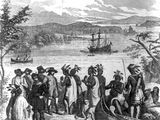
Native American locals and English colonists had a complex history in US that complex conflict as well As trade. They traded goods and ideas. Here, English explorer Henry Hudson and his gang trade with Indians on the shore.
Etching from the United States Depository library of Congress
fatal accident
Noun
person who has been injured or killed in a precise incident.
colony
Noun
people and land set-apart by outstrip or culture from the authorities that controls them.
Noun
learned behavior of people, including their languages, belief systems, social structures, institutions, and material goods.
infrastructure
Noun
structures and facilities necessary for the working of a company, much as roads.
reserves
Noun
group of clawed, ordinary citizens who are called up for emergencies and are not full-time soldiers.
Puritanic
Noun
member of a strict Protestant scrupulous and political mathematical group that originated in England in the 1500s.
Noun
land an animal, weak, or government protects from intruders.
wampum
Noun
string of beads utilized every bit currentness aside some Aboriginal American groups.
what was the southern colonies relationship with the natives
Source: https://www.nationalgeographic.org/article/new-england-colonies-and-native-americans/

Posting Komentar untuk "what was the southern colonies relationship with the natives"